
Case study · hipages
Tradie Subscription Value — Closing the retention loop through profiles and analytics
Tradies win work when homeowners trust them, and 80% of homeowners check a tradie's profile before hiring. Yet most tradies had never updated theirs, and some didn't even know homeowners could see it. I led a redesign that put their best work and reviews up front and let them update it themselves.
- Role
- Lead Product Designer, Growth
- Year
- 2023
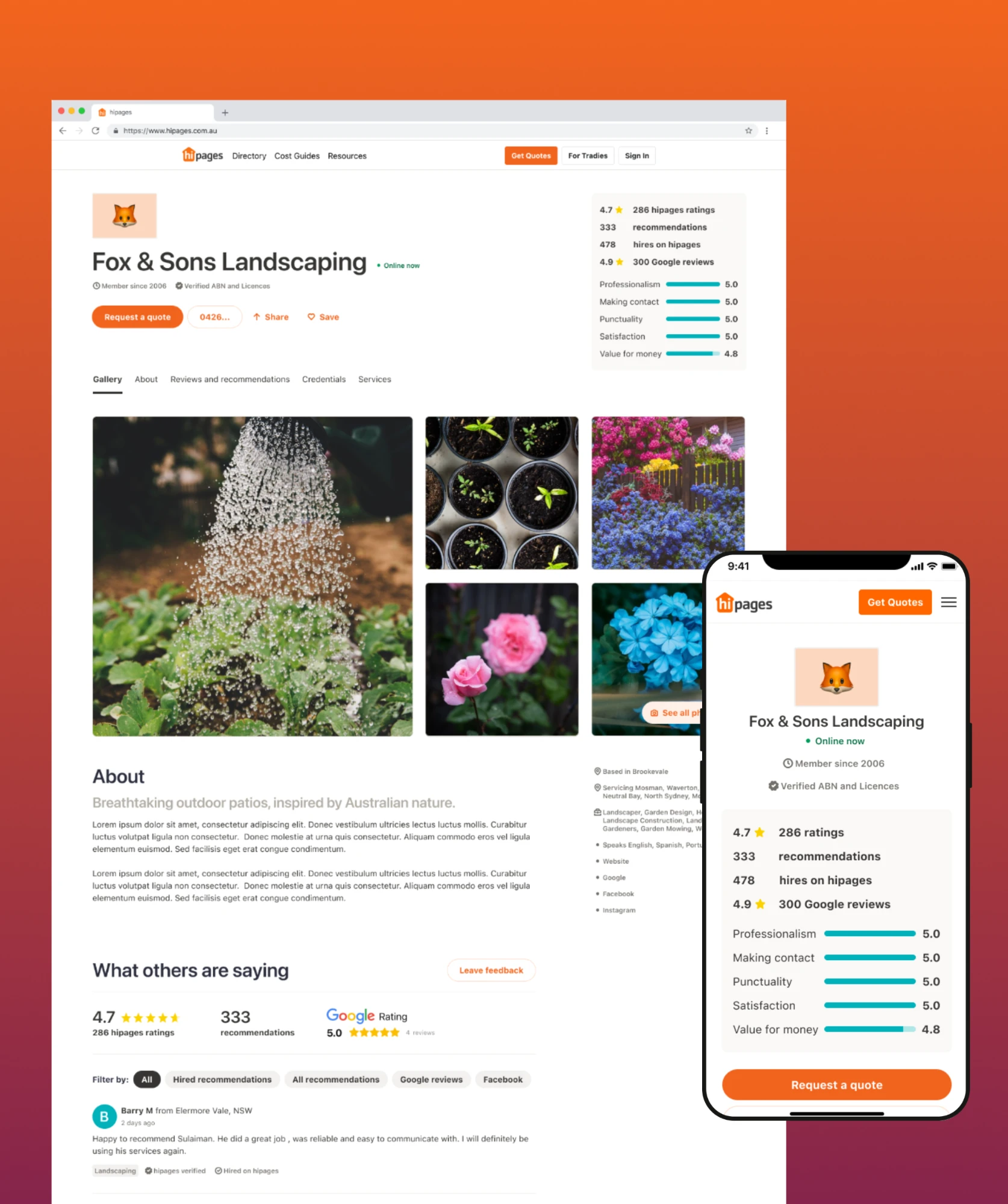
Overview
For a tradie, a profile that looks the part is the difference between winning a job and losing it to the next quote. hipages is a marketplace connecting tradies with consumers doing home improvements. A consumer posts a job; tradies spend lead credit to claim it; up to three can claim a single lead and the consumer picks.
As Lead Product Designer in Growth, I drove this retention initiative from strategy to launch, across discovery, research, testing and go-to-market.
Objective
Surface the value of the hipages directory and profile pages to tradies, increasing their subscription engagement beyond leads and reducing churn.
Tradies couldn’t see what their profile was worth
The commercial problem underneath all of it is churn.
Profile pages were critical for consumers deciding which tradie to hire, but they carried little depth and few trust signals. From a tradie’s perspective, the benefits of the directory and their profile weren’t communicated in any way. And the ratings and reviews system was overdue an upgrade, for both sides.
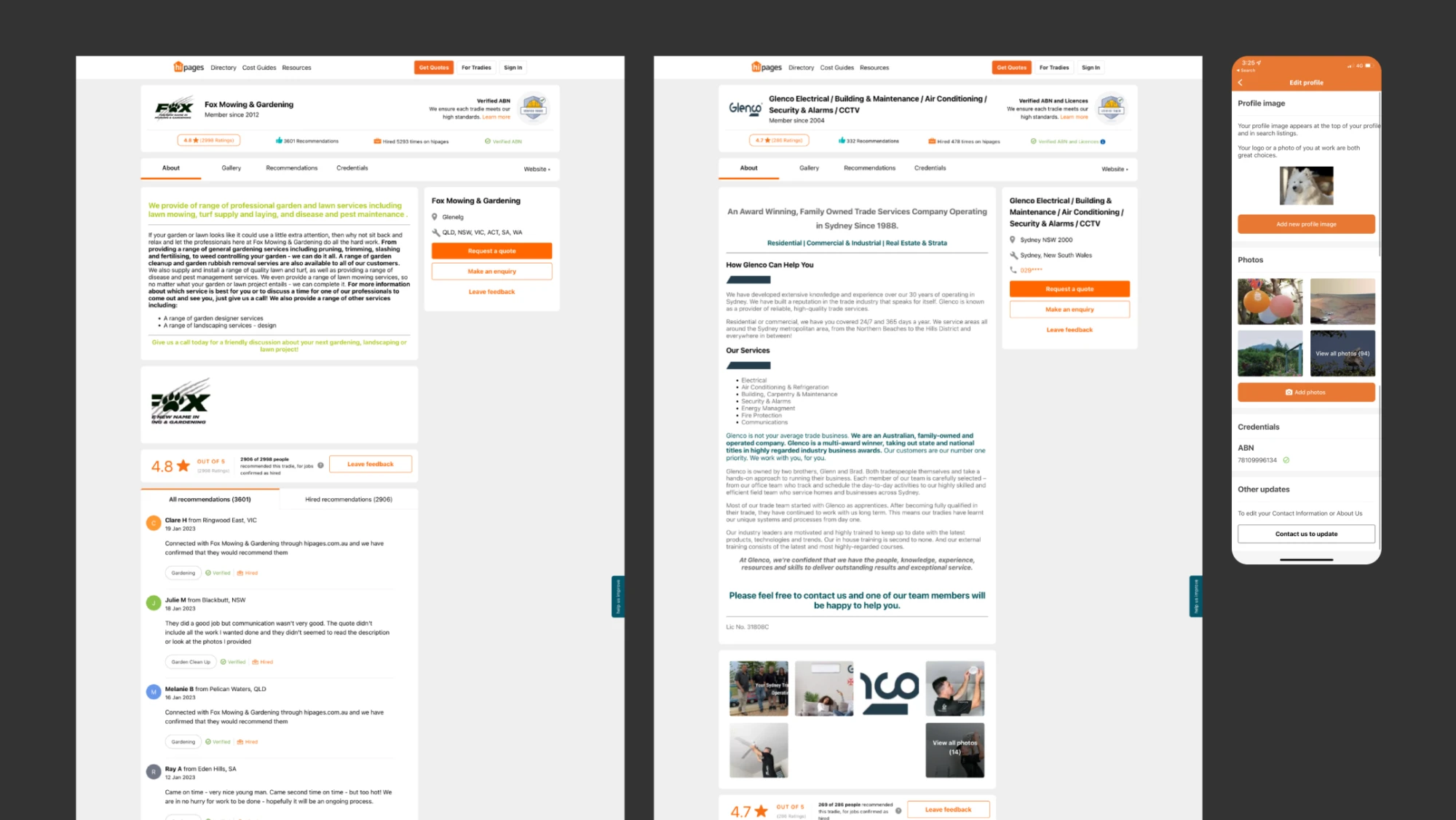 Before: dense, dated profiles on the web, and an edit screen in the app where most changes meant contacting support.
Why it mattered
- 80% of consumers view a tradie’s profile during the hiring process. It’s critical to a tradie’s ability to win work, and a tradie who wins work is less likely to churn.
- The directory is a key asset for non-brand SEO jobs, delivering significant claim value, mostly reached via Google search.
- Navigation to the directory in app and web was difficult after previous work centred on Get Quotes.
- The zero-claim rate for direct enquiry jobs via the directory was very high.
- We surfaced no ROI information on the directory to tradies at all.
- Not all tradies benefited: 50% received five or fewer profile views a month.
The loop we set out to build
Consumers were already looking at profiles. The profiles just weren’t good enough to win them over, and tradies had no idea anyone was looking. Fix both, and each turn of the loop gives a tradie another reason to stay subscribed.
- Consumers check profiles. 80% look before hiring.
- Better profiles build trust. Gallery, reviews, ratings.
- Tradies win more work. +94% views, +32% hires.
- Analytics show the value. Views, impressions, leads.
- Tradies keep it fresh. Self-serve edits and nudges, and the loop starts again.
Discovery
This landed in strategy season: we needed a business case for a dedicated team in this problem space. With no PM or data analyst at the time, I drove the strategy myself, with support from my manager on commercialisation and finance on revenue predictions.
- Multiple discovery workshops with the squad and key business stakeholders
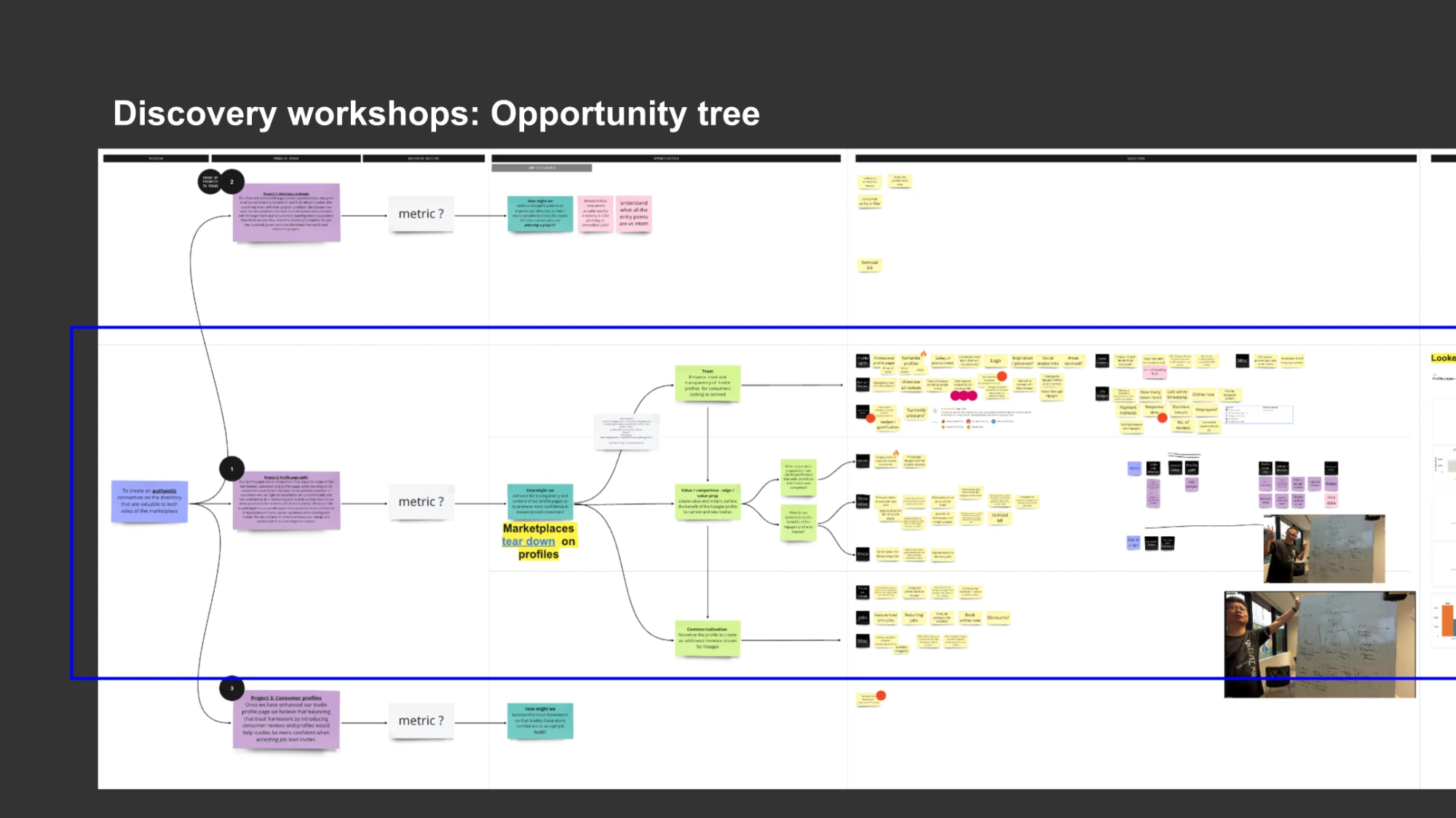
- Opportunity tree mapping, laddering up to company OKRs
- A stakeholder interview with the CEO on his vision for the space
- A review of prior research, including the “Wall of Pain” and JTBD work
- Competitor teardowns and learnings from our partner businesses
- User journey mapping and funnel analysis
Opportunity tree
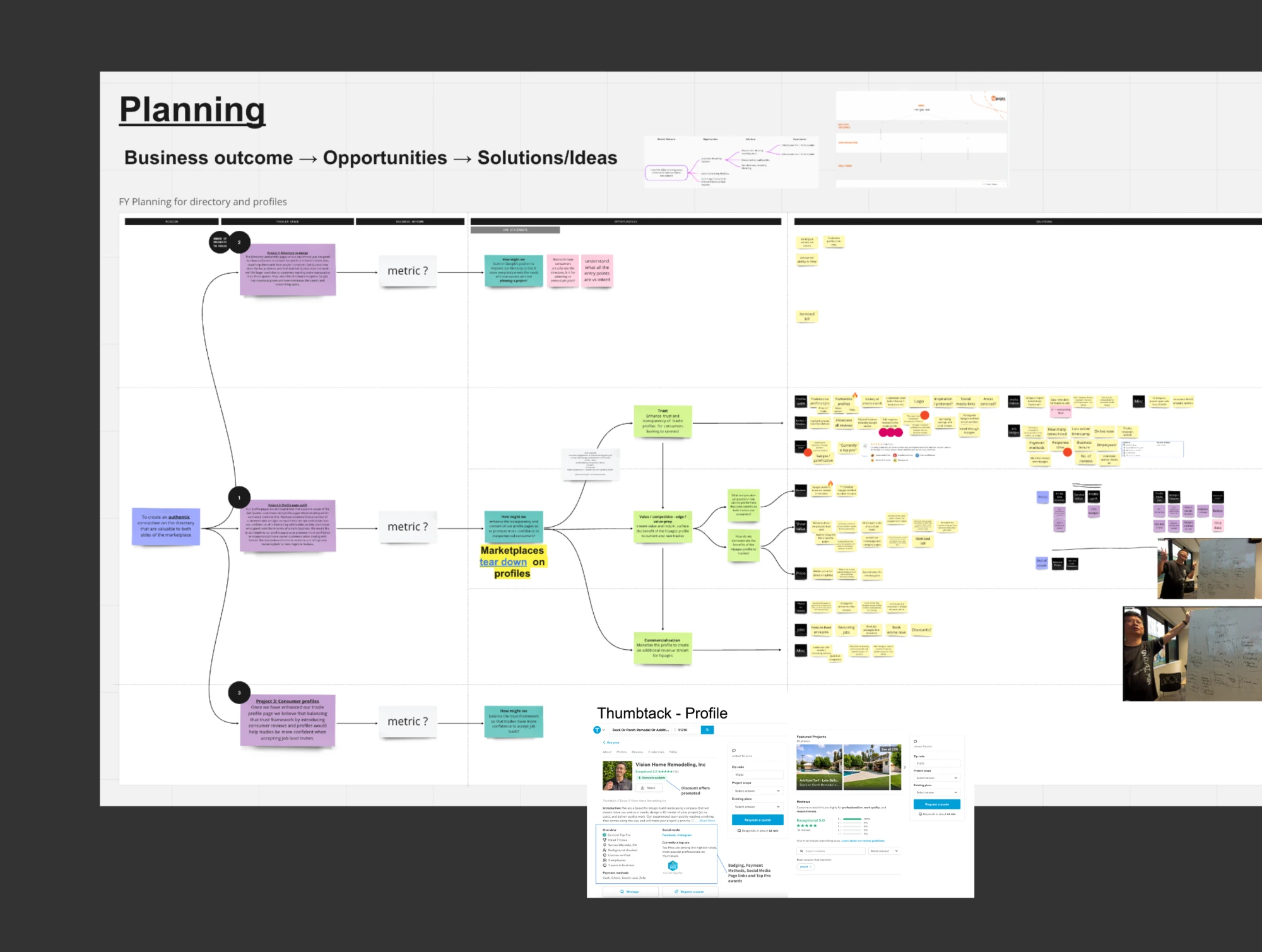
I mapped the space from business outcome to opportunities to solutions. The mission, create an authentic connection on the directory that’s valuable to both sides of the marketplace, broke into three projects: a directory redesign, a profile uplift and consumer profiles. We focused on the profile uplift, and its opportunities split into trust, value and commercialisation.
The planning sat alongside teardowns of how other marketplaces handle profiles, like Thumbtack’s badging, payment methods and social links.
JTBD research
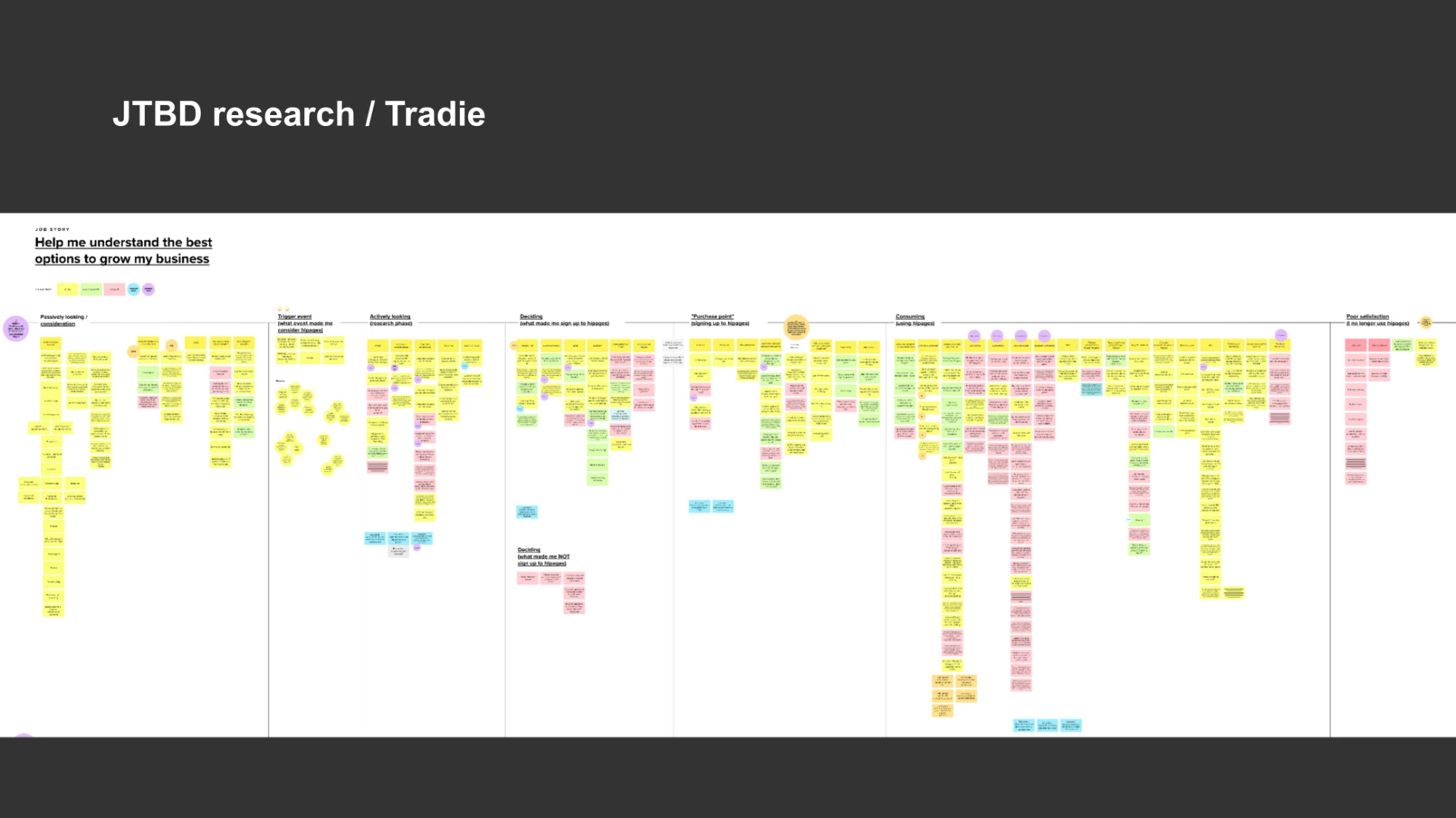
Existing jobs-to-be-done research gave us the tradie’s side of the story. The job story, help me understand the best options to grow my business, mapped from passively looking, through the trigger to sign up, to using hipages and the point where satisfaction drops off.
Consumer journey and funnel analysis
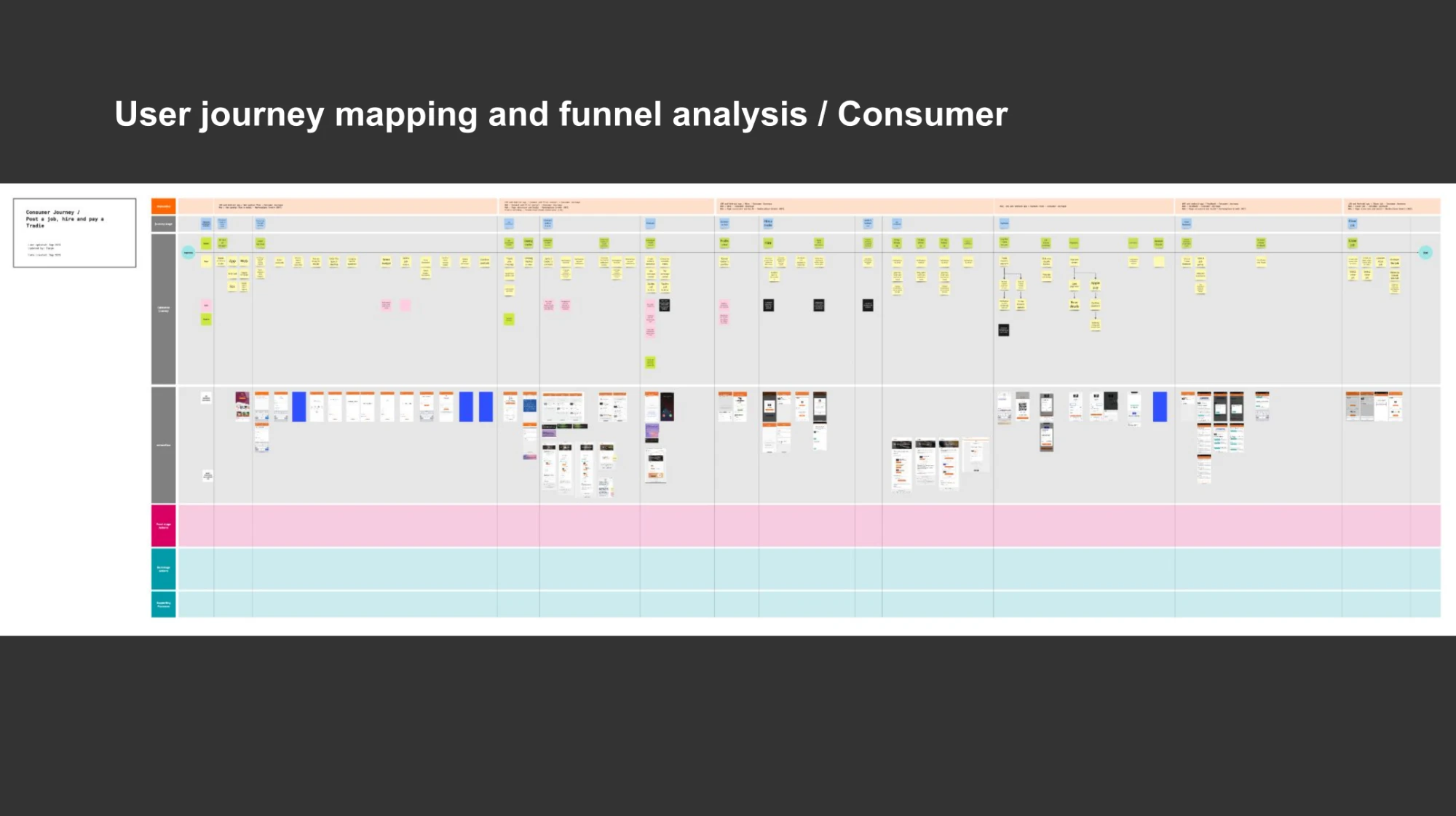
On the other side of the marketplace, I mapped the consumer journey to post a job, hire and pay a tradie, alongside the funnel data at each step. This is where the weak path from a connected job to a tradie’s profile showed up. That became the Job Connect experiment further down.
Research
By this point we had a PM. We ran user interviews and surveys on both sides of the marketplace, with a higher-than-normal response rate, and I did all of the research synthesis.
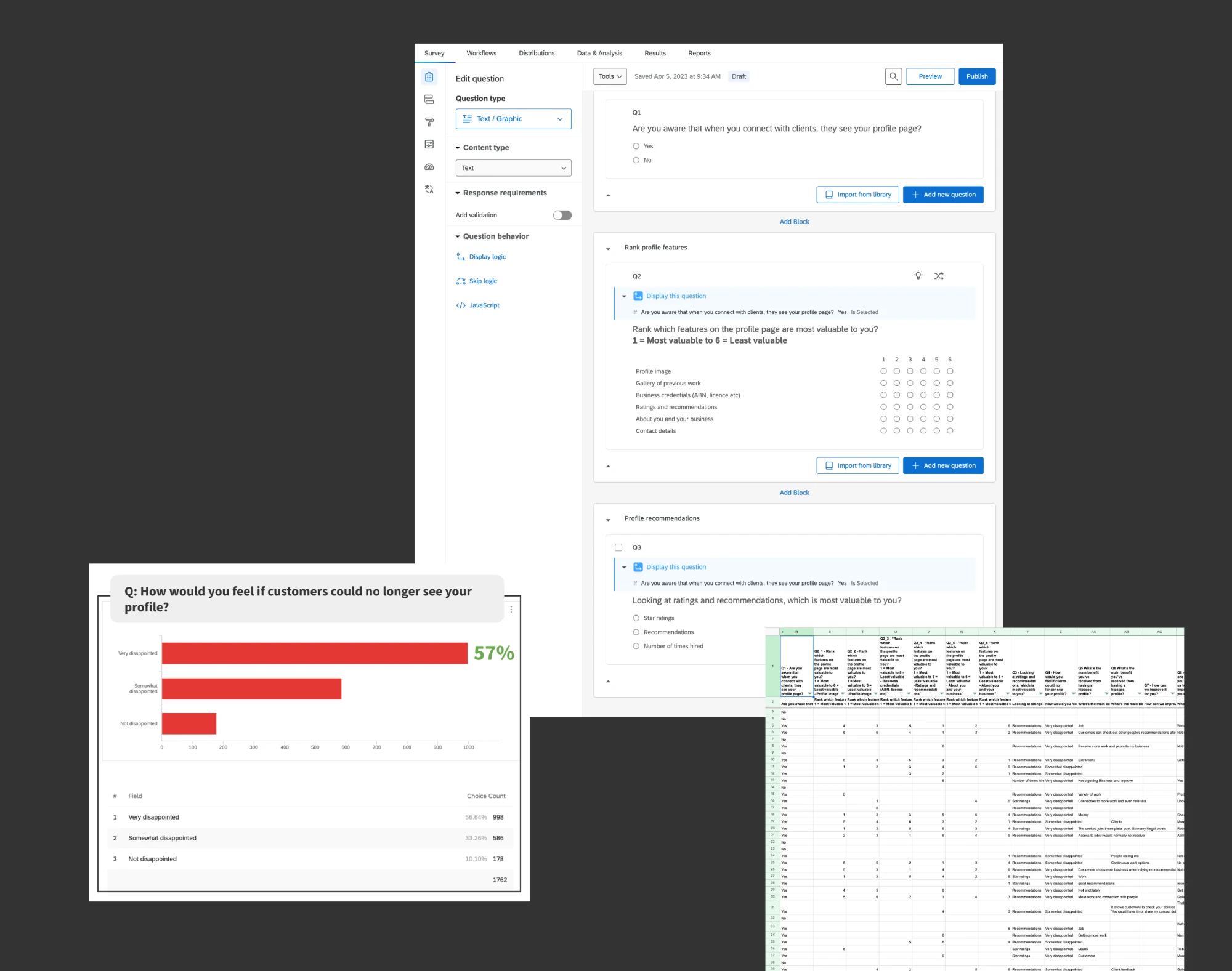
We needed a way to track perceived value over time, which is hard to measure directly, so we borrowed the Sean Ellis test: asking tradies how they’d feel if customers could no longer see their profile. Above 40% “very disappointed” indicates real value. Our baseline from 1,762 tradies came in at 57%, and it became the proxy metric for the whole initiative.
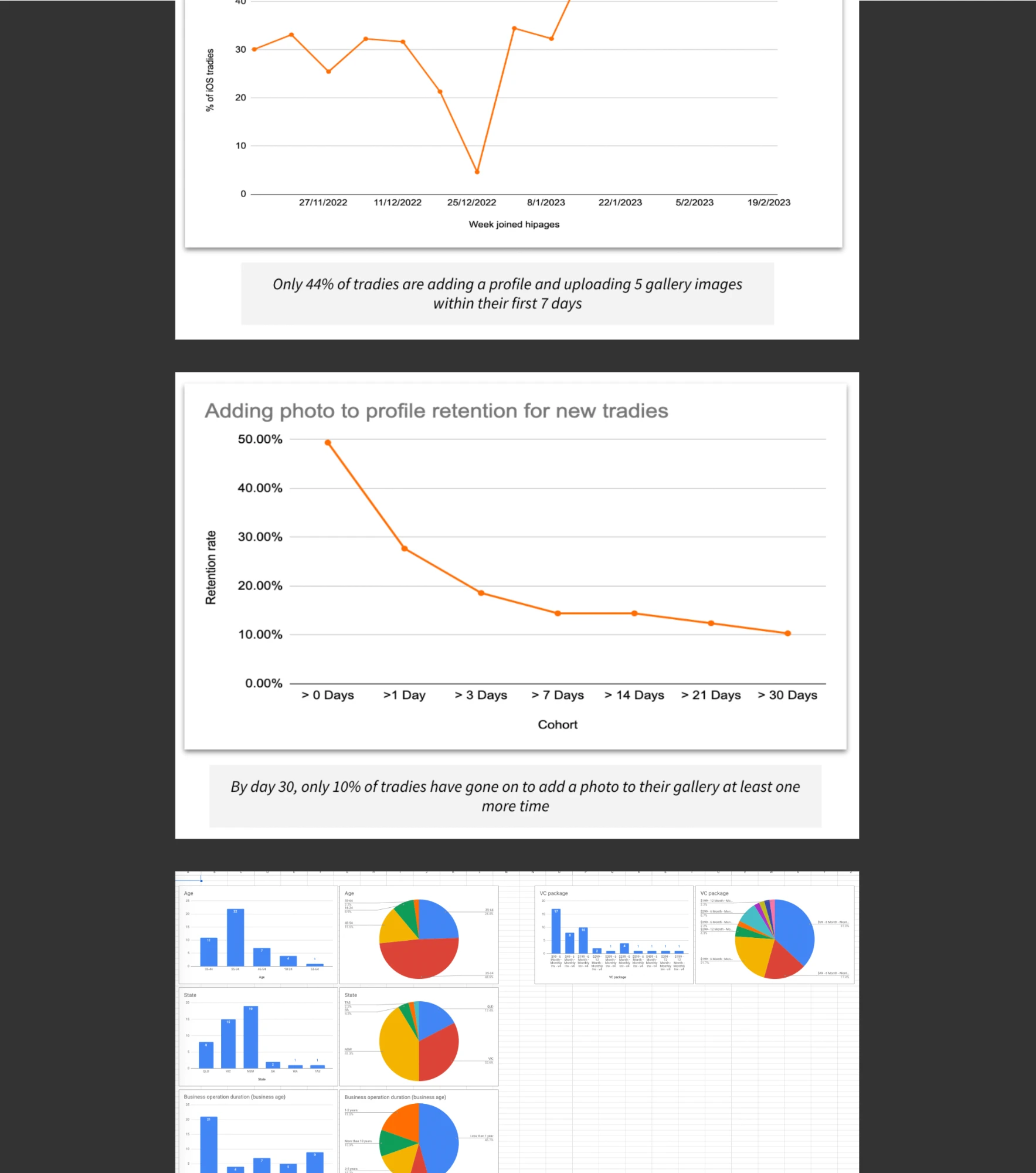
The behavioural data told the same story. Only 44% of new tradies added a profile and uploaded five gallery images in their first seven days. By day 30, only 10% had gone back to add another photo.
What we learned:
- 61% of tradies had never updated their profile after signing up
- 15% weren’t aware consumers see their profile once they’re connected
- Ratings and recommendations are the highest-value feature for tradies who are aware of their profile
- 52% of tradies have reviews on Google, Facebook or both, and 83% of those would publish them on hipages
Asked for one thing to improve, tradies put ratings and recommendations first (27.6%) and the gallery second (20.2%).
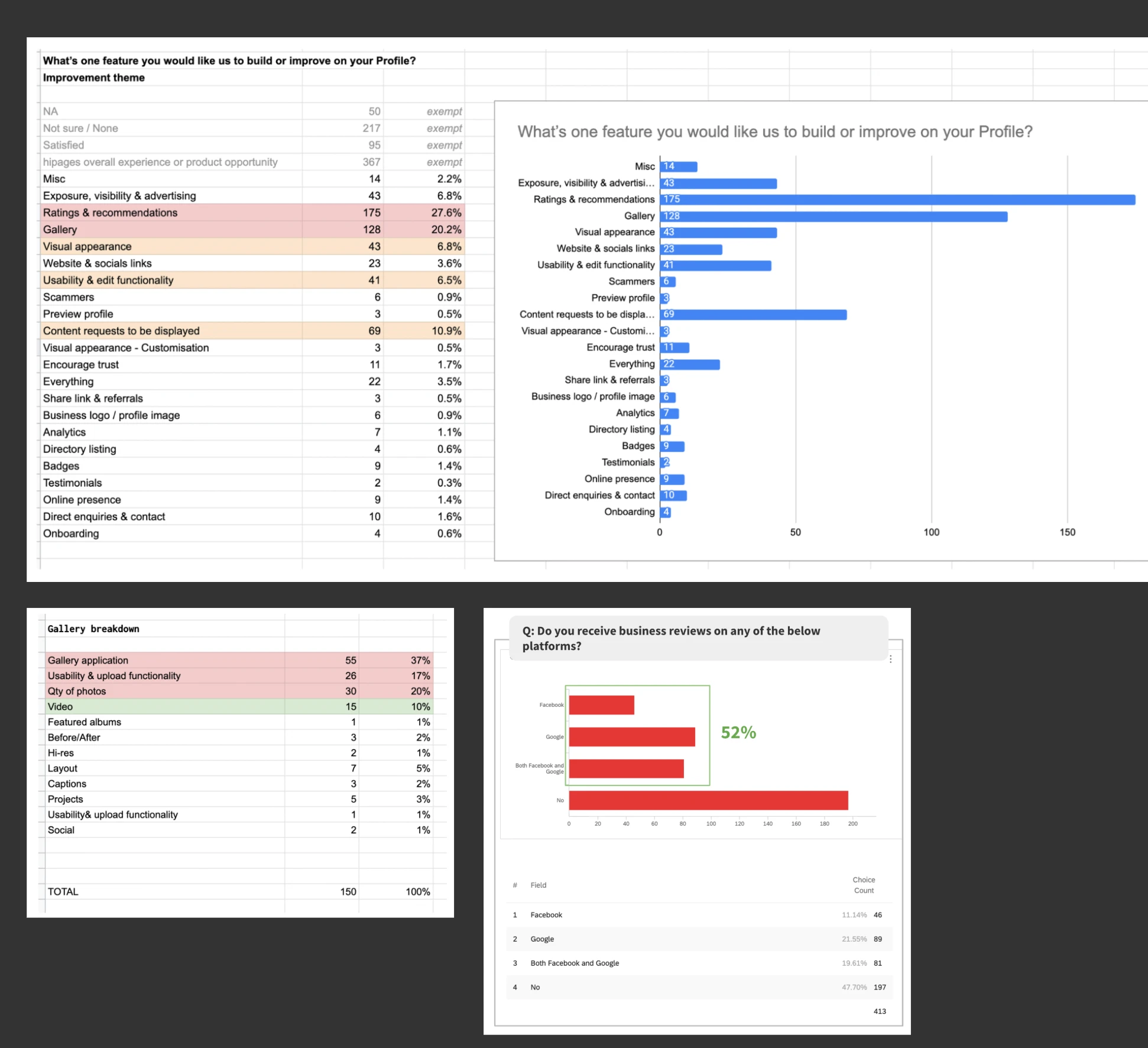
Top pain points: uploading and sorting images, surfacing reviews from external sources, writing their own bio without the graphics team’s help, and a dated, unfriendly visual appearance.
Ideation
- Crazy 8s with the design team, mobile-first, because our tradies are overwhelmingly on mobile
- Visual direction exploration within hard constraints, working closely with the design systems guild on an in-flight new visual language
- User flows mapped from workshop initiatives
- An initial experimentation strategy, refined with the team into a roadmap
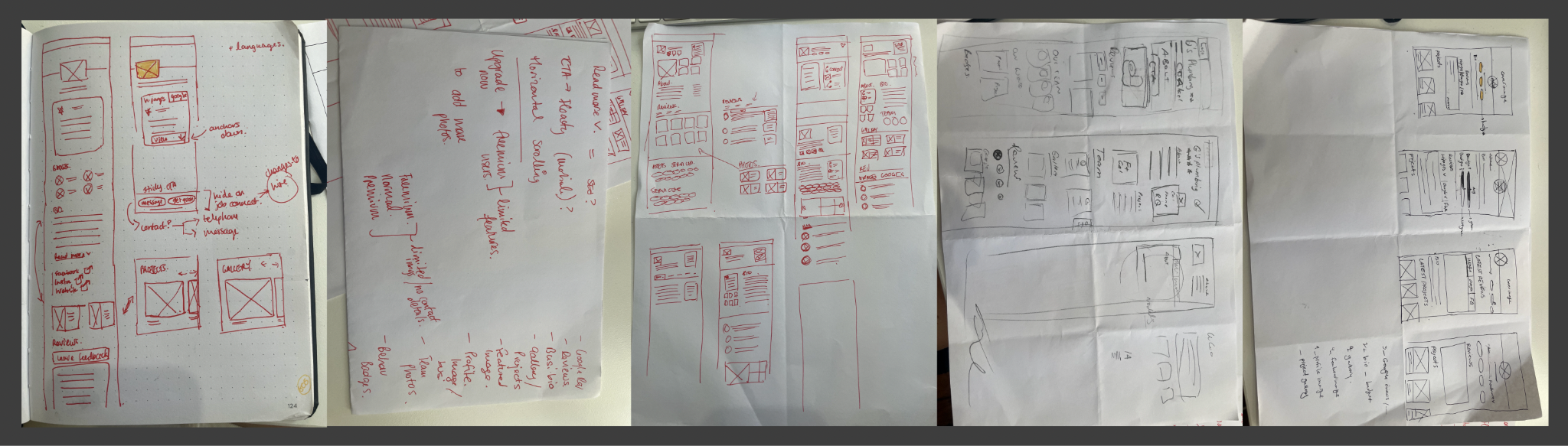
Testing and experimentation
Learning objectives
Consumers: how might we enhance the transparency and content of our profile pages to promote more confidence?
Tradies: can we improve the perceived value and overall sentiment of their listing and profile? And what’s the reaction to a better, more attractive profile that fixes known frustrations?
Early creative and usability testing
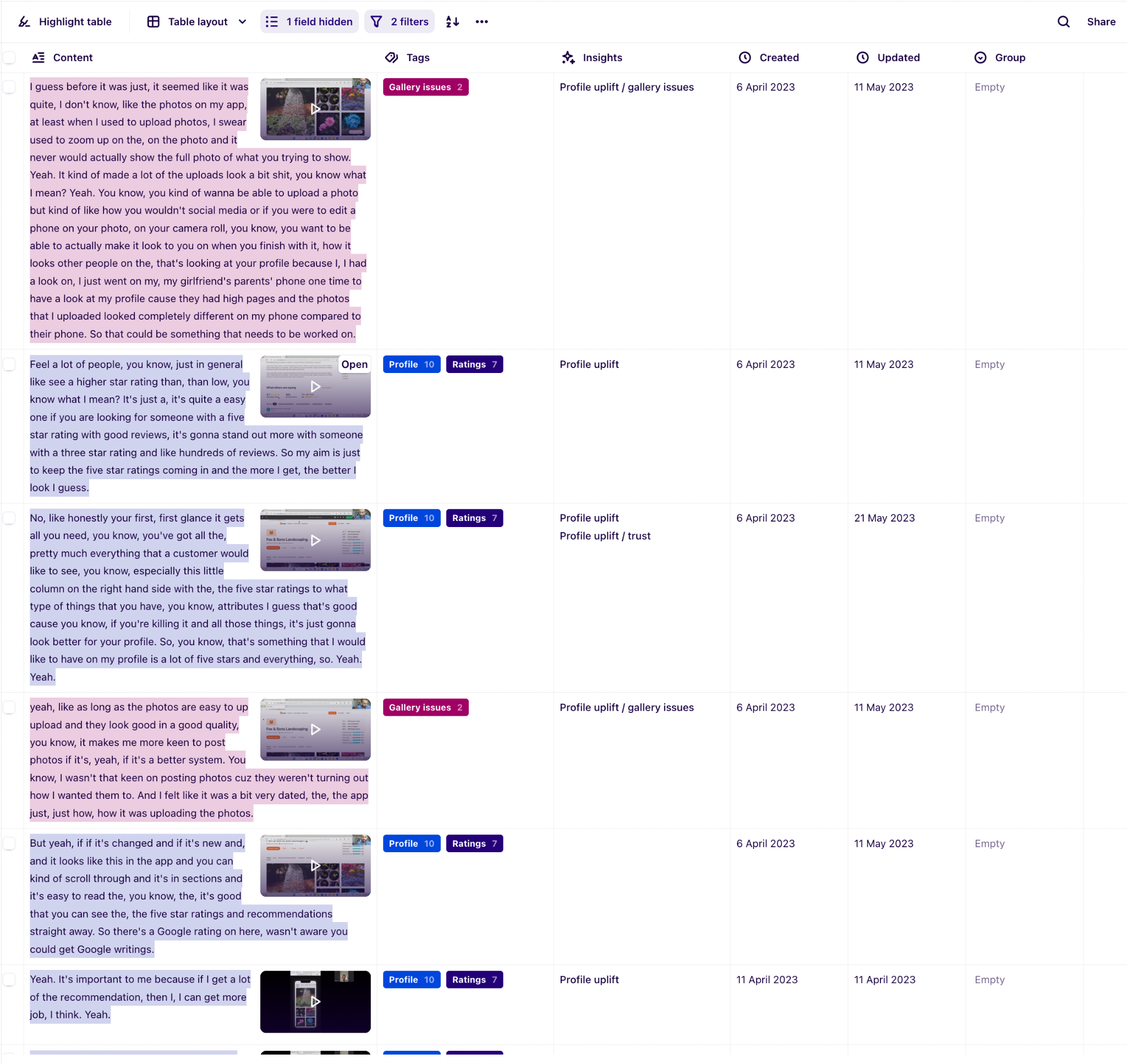
The PM and I ran moderated usability sessions with both sides, plus unmoderated testing in Useberry: card sorting, heatmaps and open-ended feedback.
I did all of the synthesis, in Dovetail, where highlight reels made it easy to share raw feedback with the team and SLT. Hearing it first-hand creates alignment that a summary never does.
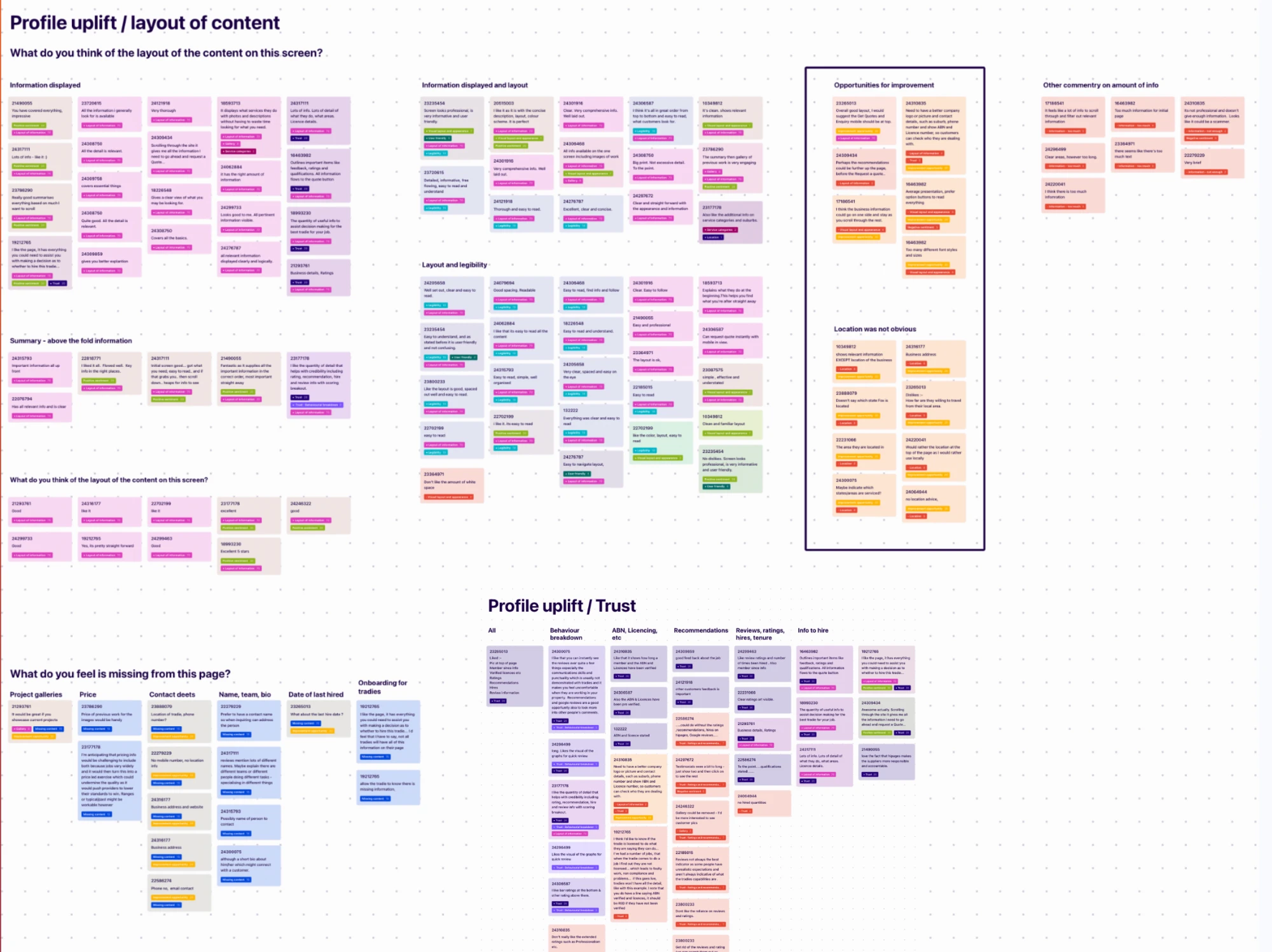
From consumers: overwhelmingly positive. Google reviews were valued most. A consistent theme was making the tradie’s location more prominent. People prefer hiring locally, both to keep money in their community and because call-out fees are lower.
From tradies: excited by the updates. They wanted nudges and reminders to keep their profile current, and more control to self-serve, including editing their own bios.
Production
- Prioritisation workshops, user story creation and backlog refinement, engineer-led
- A Customer Advisory Board check-in on the final creative
- Design system and visual asset creation
- Go-to-market strategy with marketing
- Collaboration with legal on T&C updates
Because the whole team had been involved in every activity, this ran without surprises. Feasibility sparring had happened long before.
Data improvements
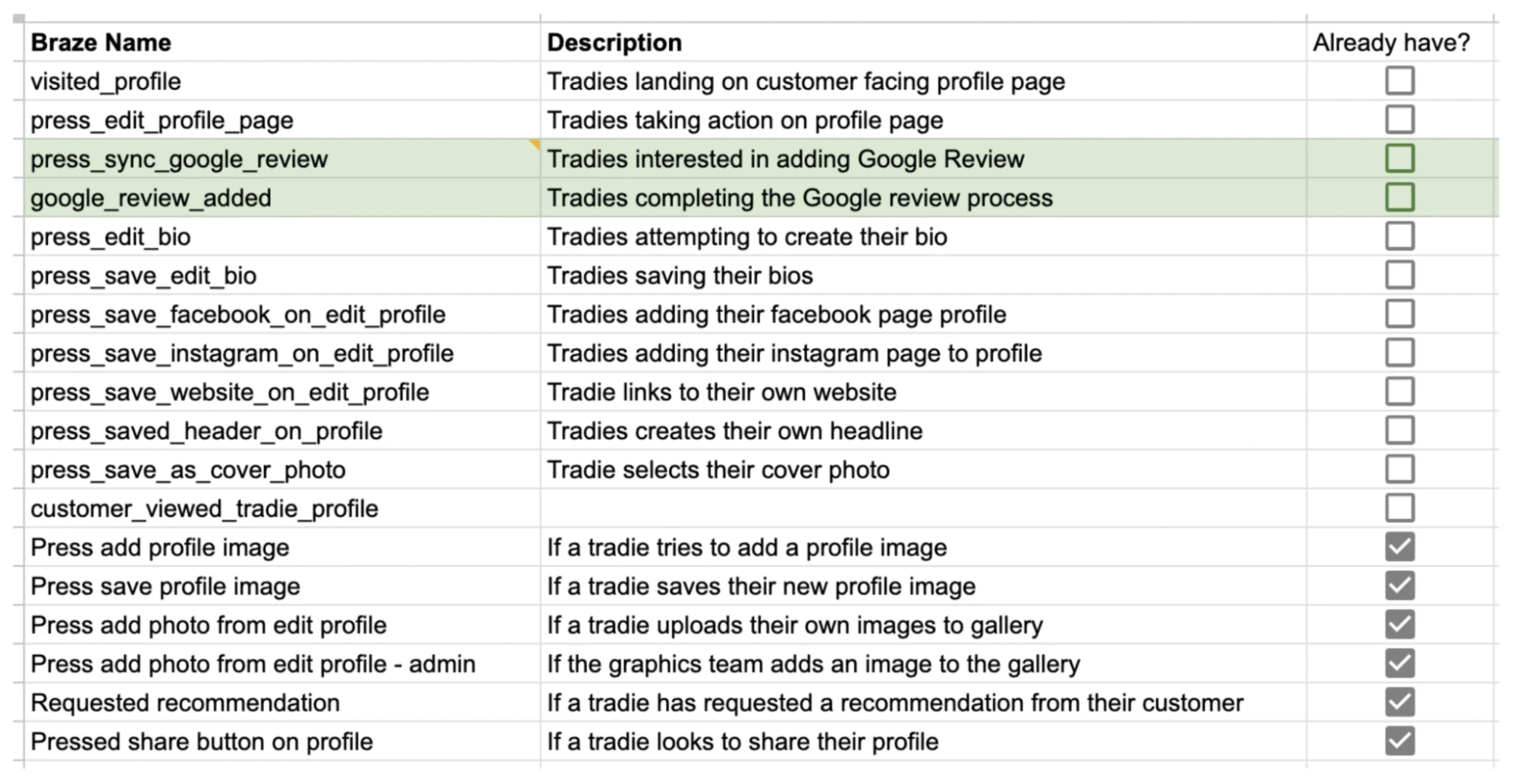
Many key events on the profile and edit experiences simply didn’t exist. We defined and rebuilt the eventing so the experience could be monitored closely and improved through experimentation. This was done with marketing, since Braze triggers depend on it.
Defining success
Leading:
- Keep tradies’ perceived value of their profile above 70% by the end of Q1 FY24
- 39% of tradies with under 30 days’ tenure to have Google reviews by 31 August
- 16% of tradies with over 30 days’ tenure to have Google reviews by 31 August
- Average profile views and hires trending up
Lagging: a reduction in tradie churn.
Customer Advisory Board
CAB feedback mostly validated earlier findings, with very positive sentiment towards the updates.
- Tradies know their profile builds their brand, but time is the problem. They want to be nudged and reminded.
- Being able to self-serve was seen as a huge benefit.
- Content was a big issue: either not having enough, or not believing their photos could compete with the best.
- The Google reviews component alone was enough to make them want to keep their profile active.
With better tracking, we could personalise those nudges: “you’ve completed 10 jobs recently, how about updating your gallery?”
The design
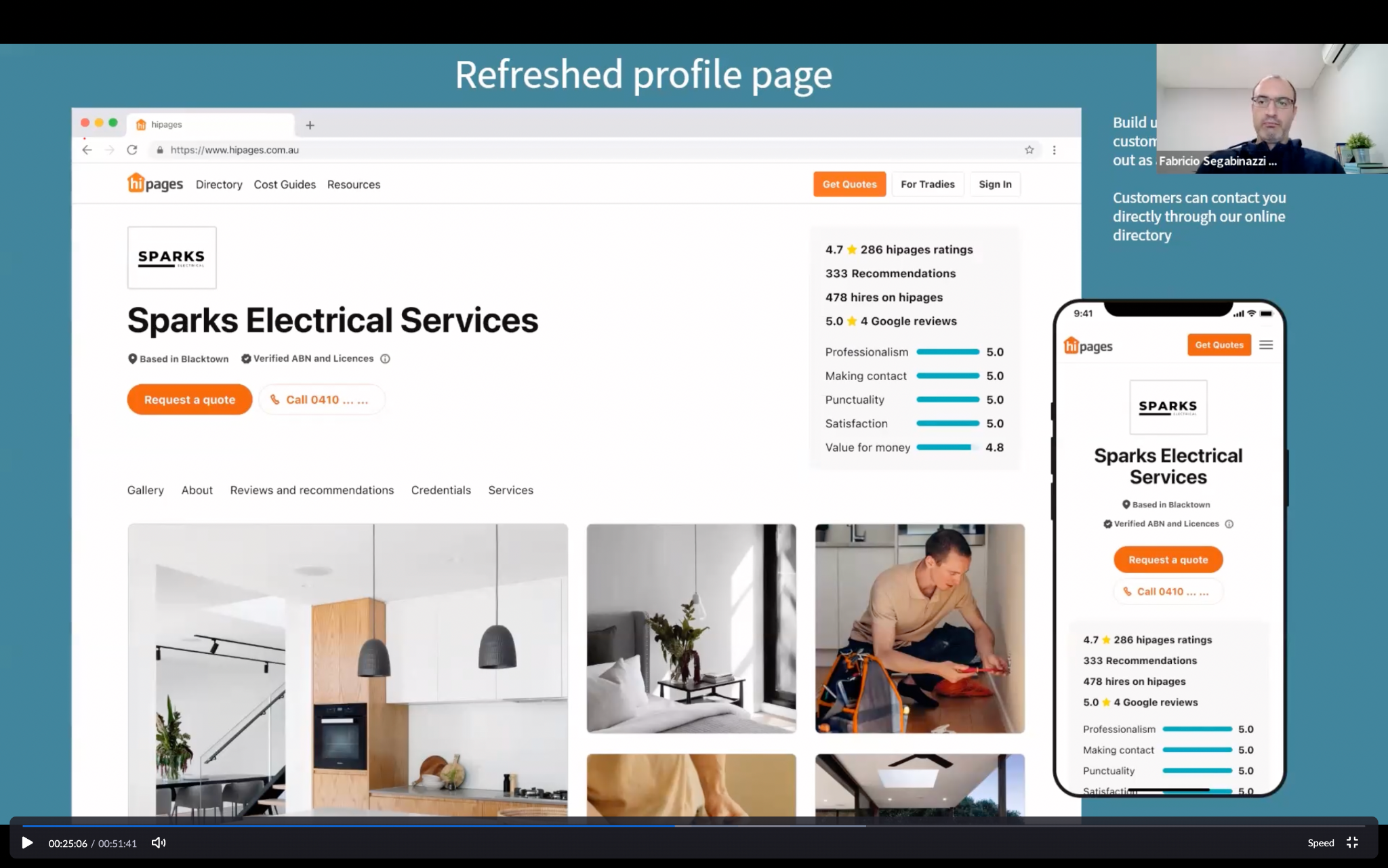
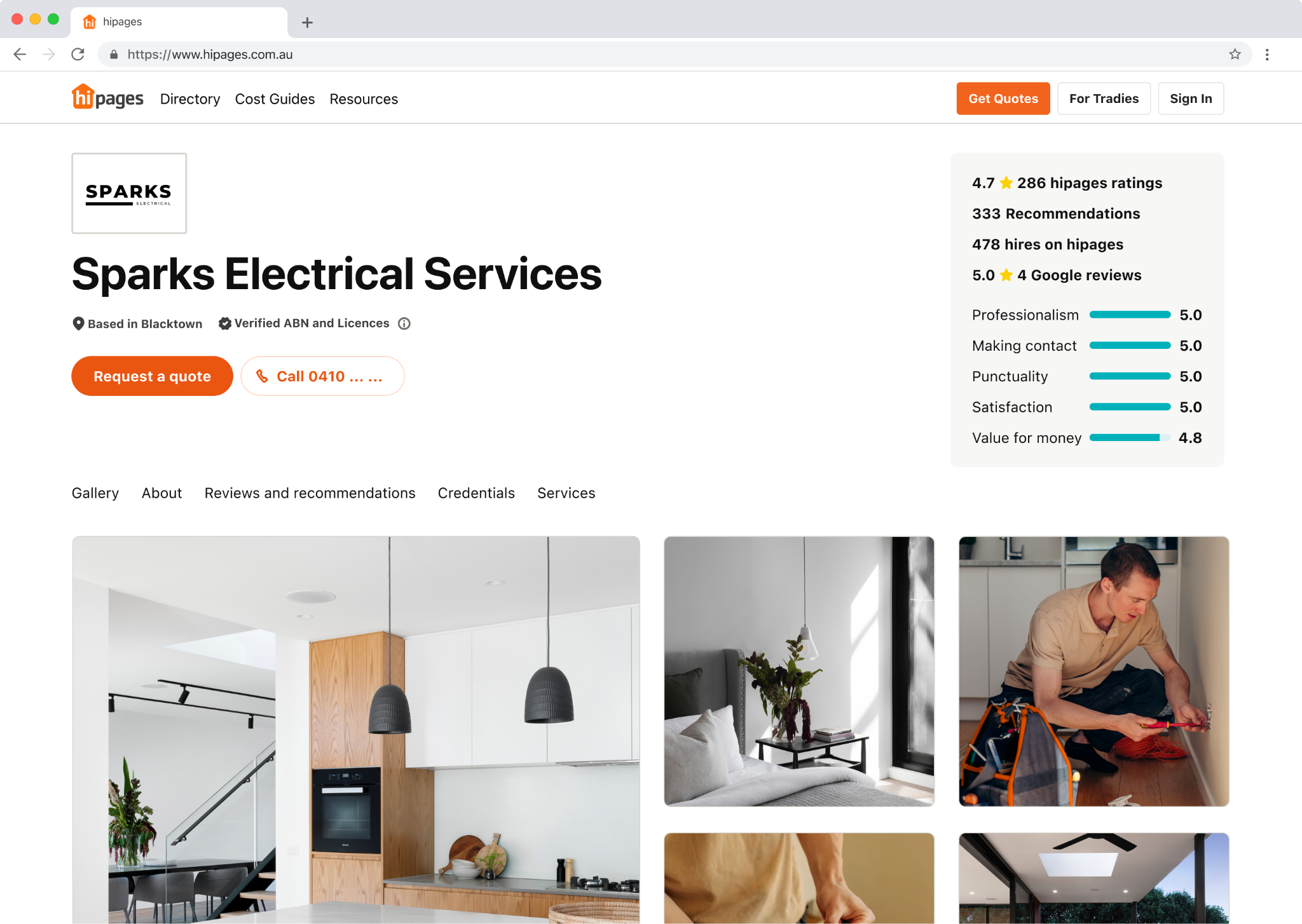
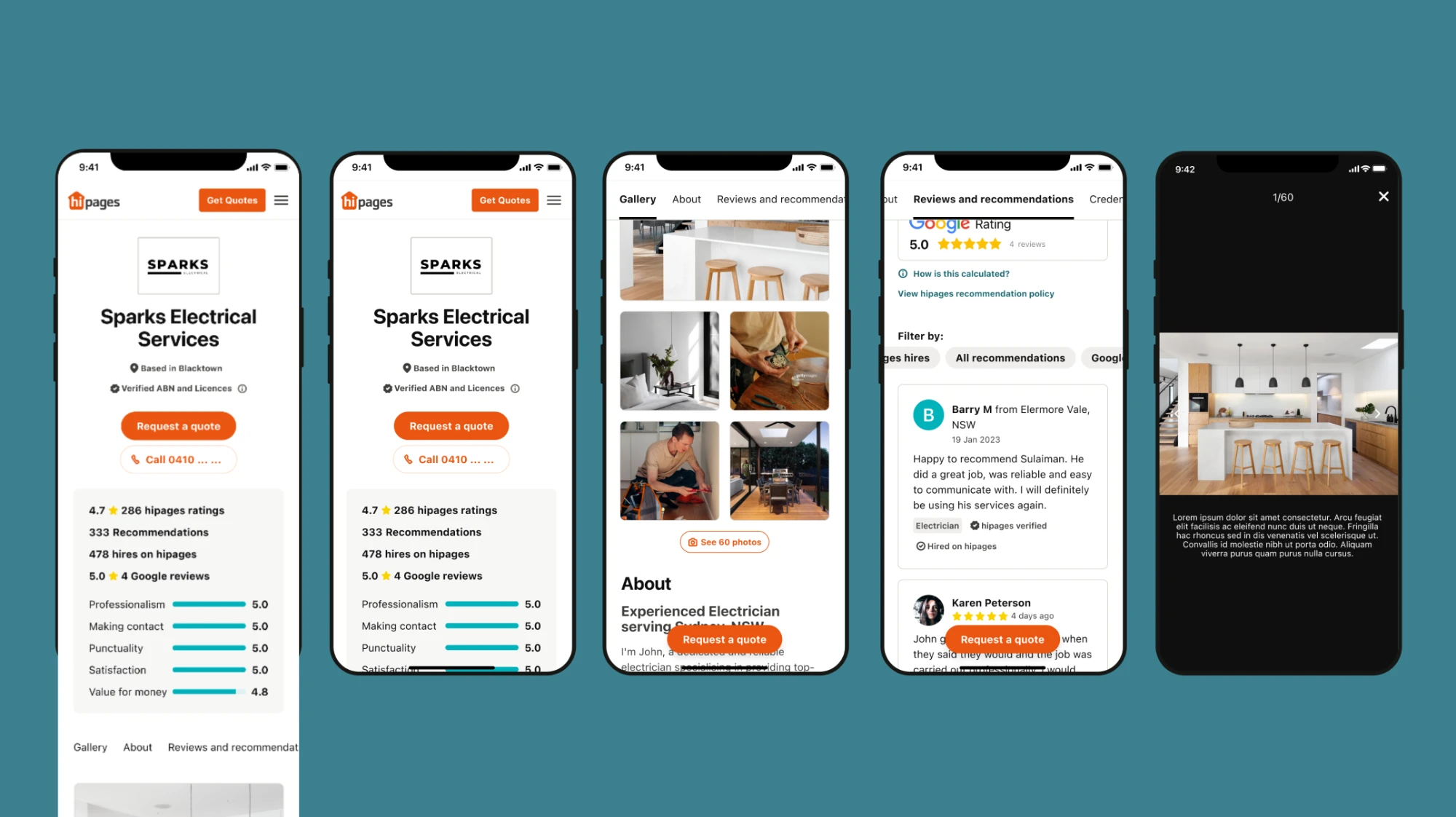
Clean and simple, with the tradie’s own content as the hero. Deliberately not customisable: consumers compare tradies side by side, so profiles had to stay legible and consistent. No MySpace.
- Ratings and reviews made far more prominent, with a behavioural breakdown that leaves room for badges and gamification later
- The gallery reworked entirely: cover photo, image uploading and sorting, drag and drop
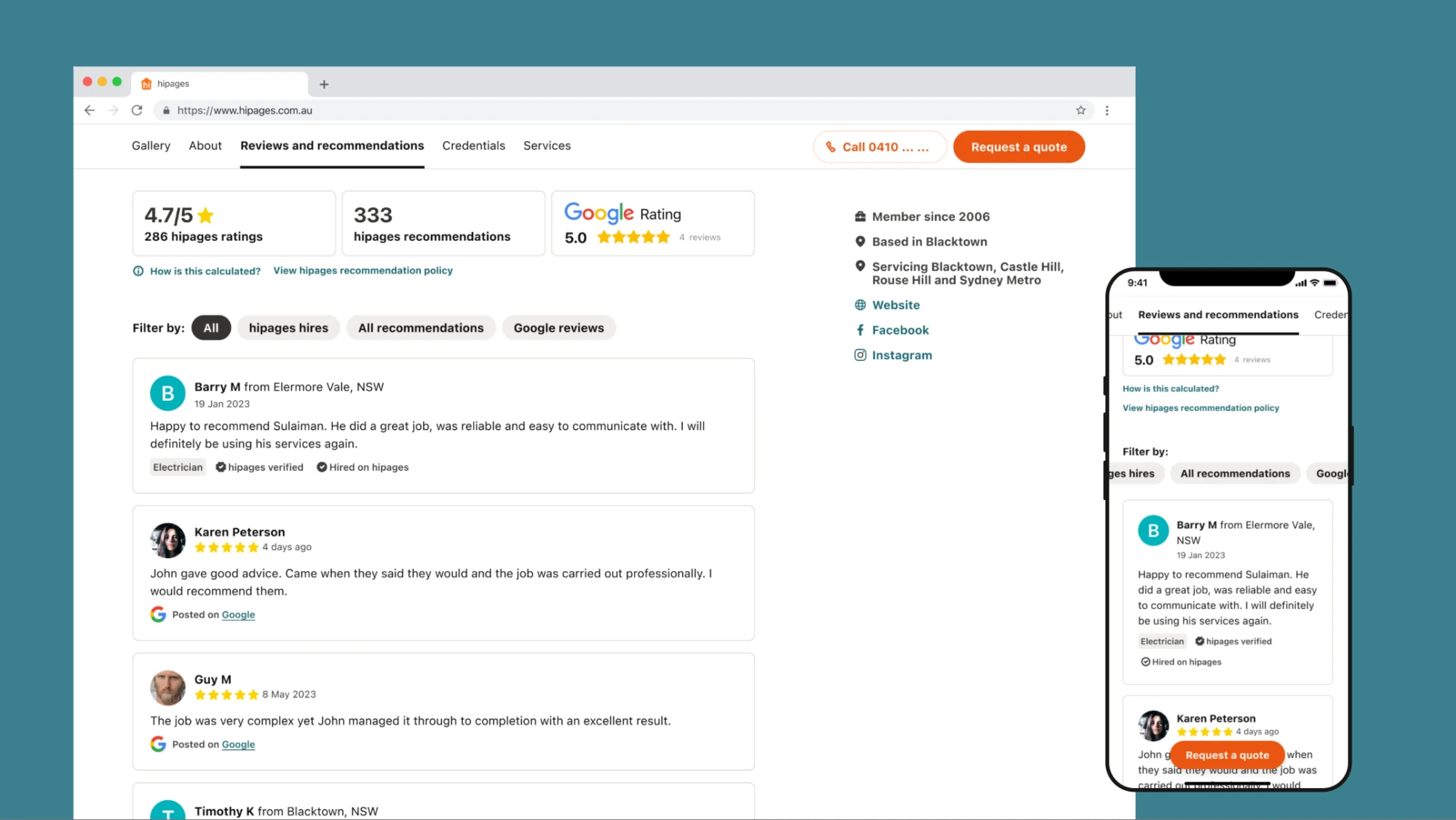
- Google reviews integrated, which took close work with legal
- A self-serve edit experience, the real unlock. Tradies no longer had to contact support to update their profile
- Social and personal website links, and editable bios
- Higher subscription tiers unlock more, such as multiple gallery components to feature several projects
Go-to-market
Working with marketing, we planned a phased launch: Google reviews first, then the rest of the uplift. I designed the promotional assets to build hype and exposure, and we tightened the success metrics and eventing before launch.
Experiments ran in parallel
While the profile redesign was being built, we ran experiments on adjacent parts of the retention loop. Each one either drove more consumers into tradie profiles, or closed the gap between a tradie’s effort and what it was worth.
Job Connect: top of funnel
Problem. Tradie profiles weren’t helping tradies win work, because the consumer path to reach them was difficult to navigate and buried in the message centre.
Hypothesis. Improving the consumer funnel to view the profiles of tradies connected to their job would increase the value of profiles as a way to win work.
Approach. The weak flow came straight out of the funnel analysis in discovery. I optimised it and ran an A/B test, first to 20% of iOS consumers, then 100%.
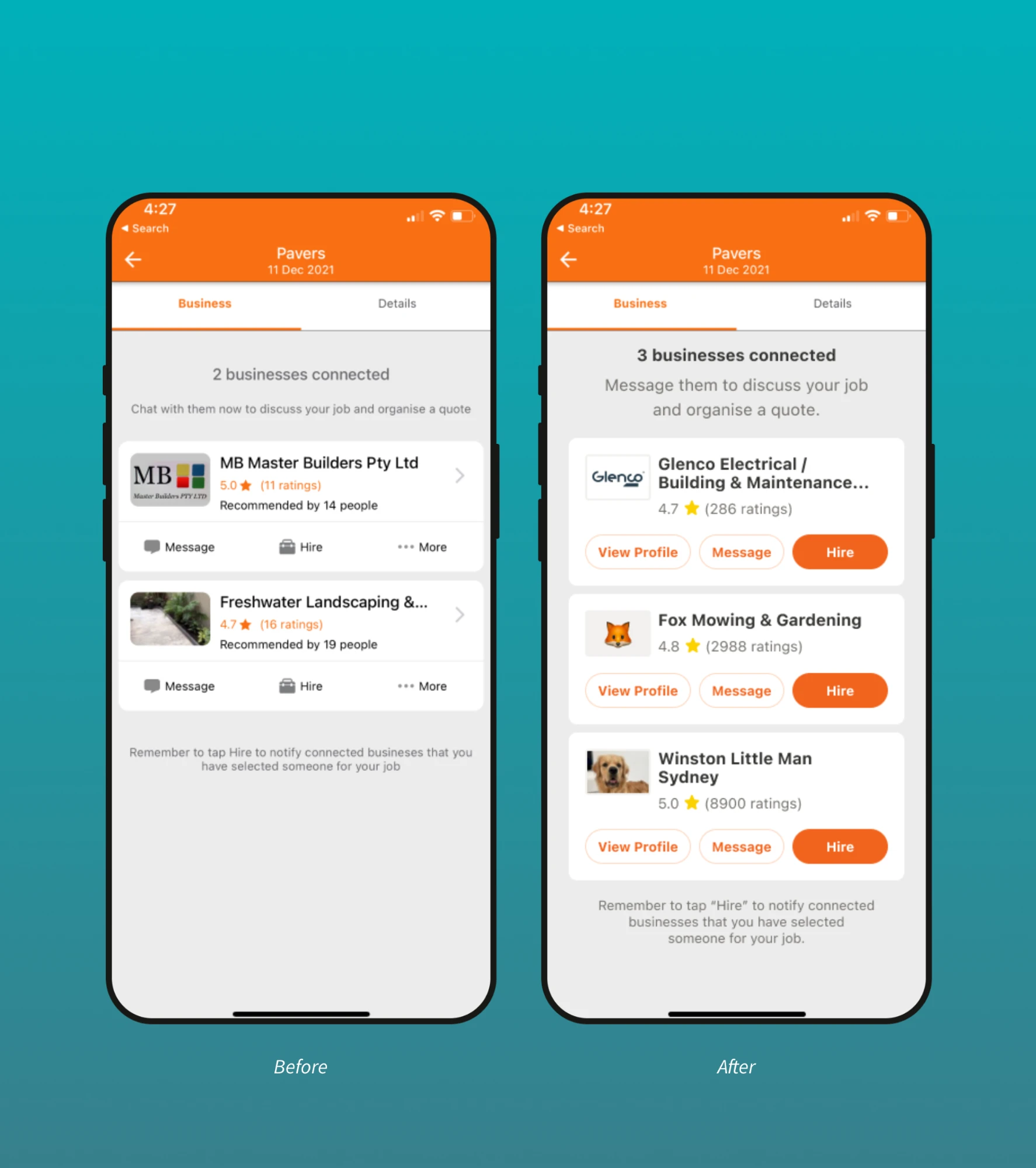
Results. The variation won significantly and was productionised. Profile views up 94%, hires up 32%, messages to tradies up 1.3%. The more interesting part was the downstream effect: a top-of-funnel change improved the very stats we were surfacing back to tradies, which raised their sense of the value hipages delivers.
Syncing Google reviews
Problem. Tradies want to showcase their business and stand out, but new joiners arrive with no hipages ratings yet. It’s the cold-start problem of a marketplace reputation.
Hypothesis. Tradies would value their profile more if they could showcase reviews from external platforms, especially early-tenure tradies.
Approach. We ran an earlier proof of concept in the iOS tradie app before building the production experience, with a cohort drawn from survey respondents.
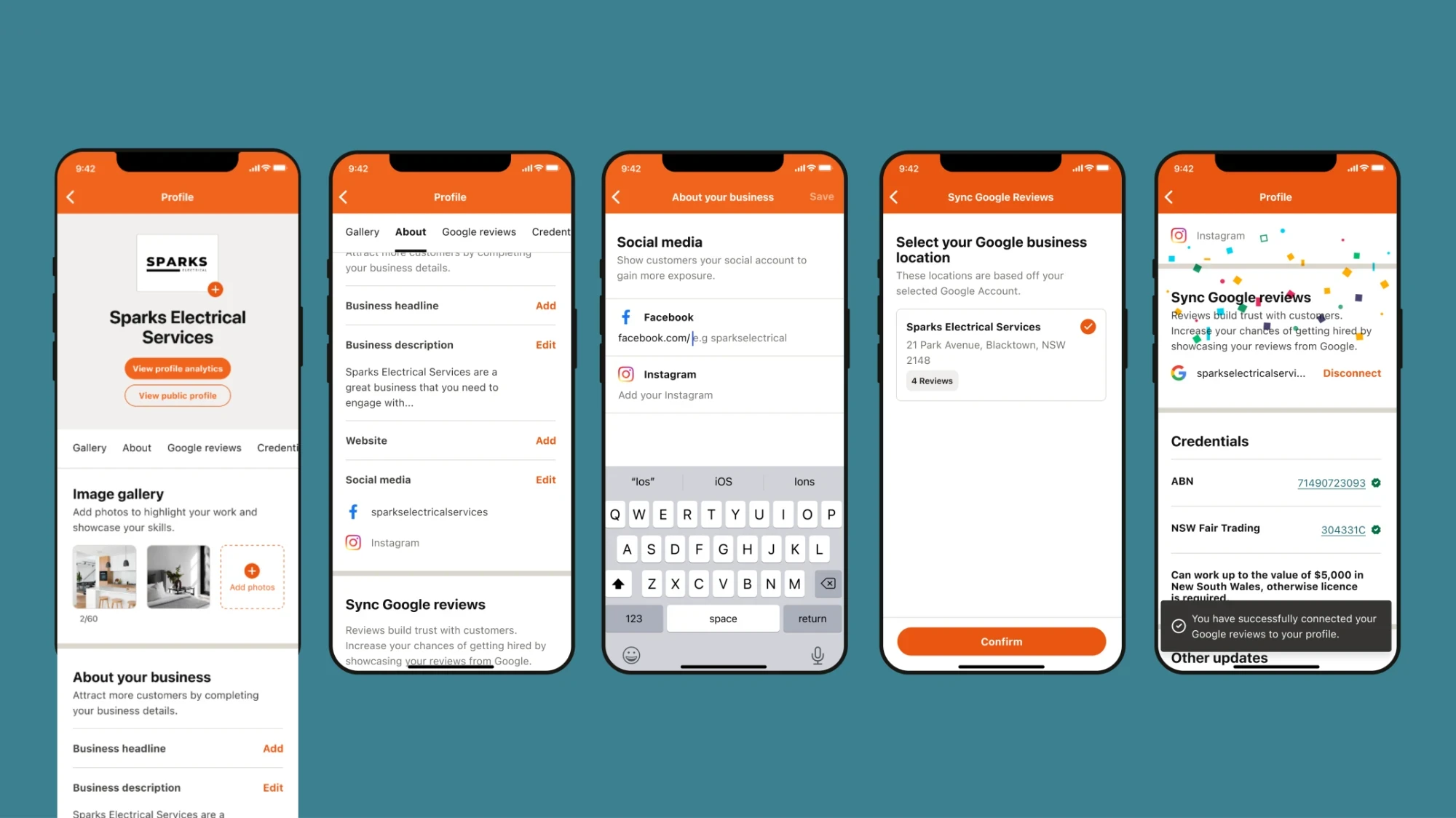
Results. High uptake. We paused it quickly and deliberately: we didn’t want tradies syncing their accounts only to be asked to do it again a month later. The proof of concept gave us the signal to build it properly, with legal on the terms.
Profile analytics
Problem. How might we surface the benefits of the hipages profile to tradies, to improve engagement?
Hypothesis. Giving tradies more feedback on how their profile performs would improve its perceived value and their overall sentiment.
Approach. It started as a fake-door test with an attached survey, then iterated repeatedly. I worked closely with the marketing and onboarding teams so the language matched what tradies saw everywhere else.
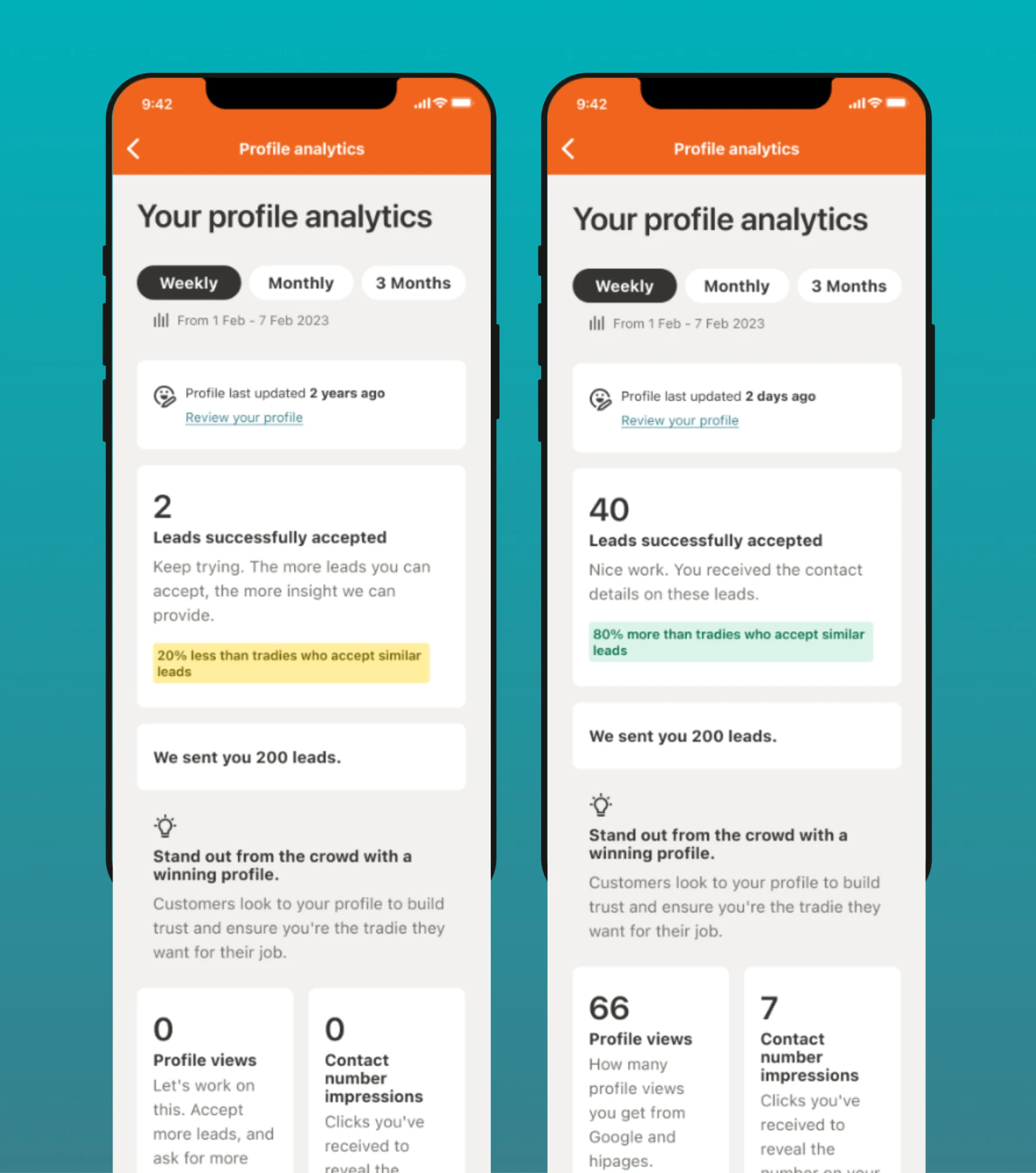
Results. High engagement. The Sean Ellis proxy metric moved from 57% to 74%, and early-stage churn analysis showed a reduction of around 40%.
“I like it, gives you idea of what’s going on. Better to have than not have. Didn’t know gallery impressions was a thing, good to know if customers are looking.” — Tradie feedback
Tradies saw the value, and stayed
The profile uplift went out in a three-phase staggered rollout, leading with Google reviews. Uptake tracked strongly. The proxy metric moved from 57% to 74%, well past the 70% target, and early churn analysis showed a reduction of around 40%.
On the consumer side, the Job Connect change lifted profile views by 94% and hires by 32%, which fed straight back into the numbers tradies now see in their analytics.
What came next
The highest-pain point from tradie research was managing gallery images. Uploading, sorting and presenting work was confusing enough that most tradies simply didn’t. The next phase tackled the upload and sort experience end to end.
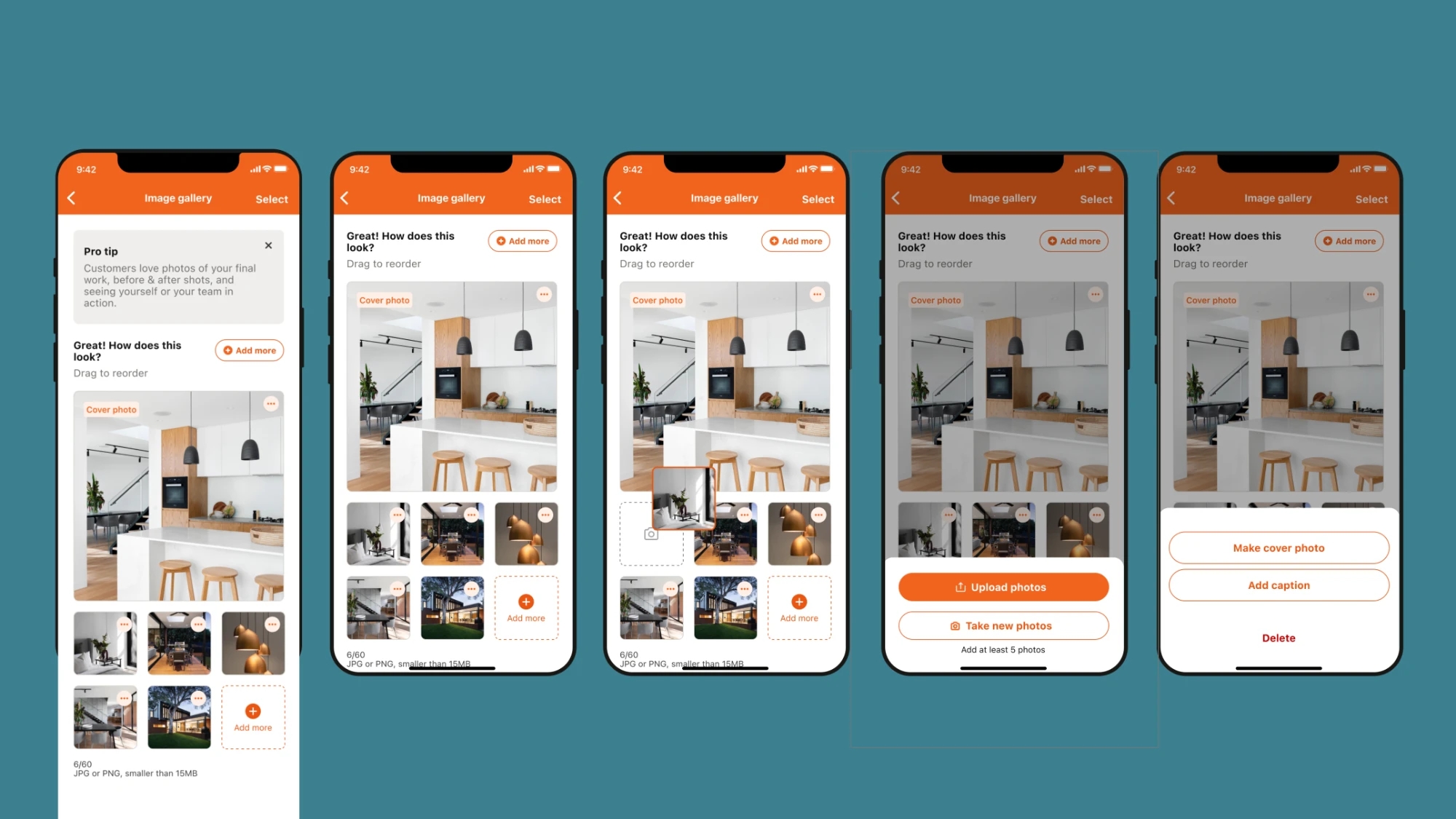
I designed the interaction before transitioning to Canva; the team shipped it after I left.